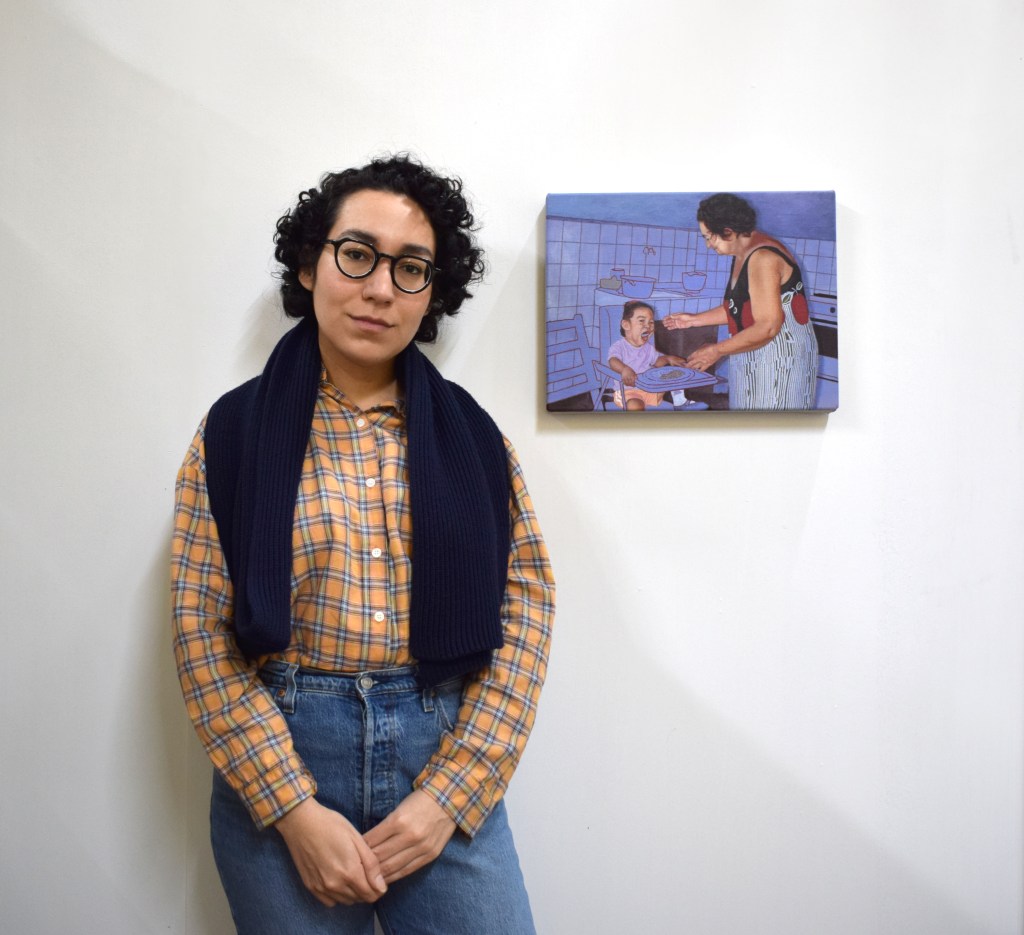
Zully Mejía (b.1997, Piura, Peru) is a Peruvian-American artist living and working in London. She earned her BFA from the University of Nevada, Las Vegas, and her MFA from Goldsmiths, University of London. Mejía exhibits internationally, and her work is held in public collections including the City of Las Vegas and the Marjorie Barrick Museum of Art. She was a contestant on series 11 of Sky Arts’ Portrait Artist of the Year in 2024. Her painting ‘America’, currently hanging in the United States Capitol Building, received a Certificate of Special Congressional Recognition by the U.S. House of Representatives. Her work has been featured in publications including ContemporaryIdentities, Re:art Issue 3, La Raíz Magazine and the cover of Profiles Issue 4.
ARTIST STATEMENT
Zully Mejía is a multidisciplinary artist working predominantly in painting. She engages with themes of identity and memory, exploring experiences of immigration, womanhood and being a person of colour. Her practice consists of both autobiographical works and dialogue-driven portraiture that affirms subjects in reclaiming their narrative. Mejia’s work aims to challenge stereotypes, evoke a feeling of recognition and encourage self-reflection and empathy.
Mejía tailors her choice of medium and visual language to each work, varying her use of colour and levels of realism to support its conceptual ambitions. Her self-portraiture is diaristic and psychologically charged, drawing on her memories to support the assimilation, structuring and integration of her lived experiences. Mejía also creates portraits of the people around her — often friends, family or acquaintances — utilising body language and bold colour to convey confidence and joy. She approaches these portraits with an ethos of care and collaboration. In a society that frequently emphasises narratives of trauma and pain for people of the global majority, these works reaffirm conditions of empowerment and happiness.
In other pieces, Mejía employs abstraction and incorporates objects and unconventional materials, which function metonymically to represent individual experiences and wider societal conditions. The objects in these works enable the development of direct and tangible connections to people, places and histories.
Mejía’s work is rooted in a commitment to expanding representations of identity and challenging dominant discriminatory narratives. Through portraiture and the use of everyday materials, she examines how visual storytelling can honour personal histories and create social change.
Recent Press:
‘In Conversation with Artist Zully Mejia’.
‘Eoghan Smith reviews issue 4 of Profiles, ed. by Clare Healy and Sarah Sturzel’.
 Zully Mejía